

Views: 215 Author: Site Editor Publish Time: 2025-09-08 Origin: Site


Technology is no longer confined to offices and climate-controlled spaces. From remote oil fields to arctic expeditions, professionals increasingly need devices that can survive brutal conditions without compromising performance. This is where rugged tablets come into play. Unlike consumer tablets, rugged models are engineered to resist shock, dust, water, vibration, and extreme temperatures. In this article, we’ll take a deep dive into rugged tablets for the most extreme environments, exploring what makes them unique, how they are tested, and why they are indispensable across demanding industries.
Extreme environments demand more than just protective cases. Rugged tablets are designed from the ground up to withstand punishing conditions. This involves specialized materials, reinforced components, and certifications that guarantee durability.
Unlike consumer tablets, rugged tablets incorporate reinforced frames, rubberized edges, and shock-absorbing internal structures. Every design decision—from battery placement to port sealing—is centered around survivability.
Most rugged tablets are tested to MIL-STD-810G/H standards, ensuring resilience against drops, vibration, humidity, and altitude. IP ratings, such as IP65 or IP68, certify water and dust resistance. Together, these certifications separate true rugged tablets from mere “tough-looking” devices.
Magnesium alloy housings, Gorilla Glass touchscreens, and sealed gaskets are commonly used. These materials prevent cracks, scratches, and water ingress, even when operating in rain, sandstorms, or snow.
One of the harshest challenges is temperature variation—devices may be used in sub-zero arctic zones or desert conditions above 50°C.
Rugged tablets use low-temperature lithium-ion batteries and touchscreens that respond to gloved hands. This allows field workers to keep productivity up without exposure risks.
High-heat environments demand thermal management and sunlight-readable displays. Anti-glare coatings and 800+ nits brightness ensure usability without eye strain.
Manufacturers conduct thermal shock tests, where tablets rapidly transition between freezing and hot chambers. This ensures internal components won’t crack or warp.
In harsh environments, drops, shocks, and vibrations are daily occurrences.
Drop Resistance:Rugged tablets often survive drops from 1.2 to 1.8 meters onto concrete. Shock-mounted SSDs and reinforced bezels minimize damage to screens and data.
Vibration Resistance:Mining, aviation, and heavy machinery introduce constant vibrations. Rugged tablets pass vibration testing to guarantee that internal circuits remain stable under continuous stress.
Screen Protection:Chemically strengthened glass prevents scratches from tools, sand, or metal shavings. Some models even allow wet or oily touch operation, useful for mechanics and field engineers.
Connectivity is critical in the field, especially when far from reliable infrastructure.
Rugged tablets often support LTE, 5G, and even satellite modules, ensuring communication in deserts, mountains, and oceans.
Dual-frequency GNSS ensures precise navigation, invaluable for surveyors, explorers, and rescue teams working in unmapped areas.
Unlike slim consumer tablets, rugged devices retain full-sized USB, HDMI, and serial ports, allowing direct connection to industrial equipment.
The need for rugged tablets spans multiple high-risk sectors, each with unique demands.
| Industry | Key Rugged Tablet Benefits |
|---|---|
| Oil & Gas | Explosion-proof models, remote monitoring, safety compliance. |
| Construction | Dustproof operation, blueprint access, real-time site updates. |
| Military & Defense | Secure communication, night-vision readable displays, encrypted data protection. |
| Healthcare | Disinfectant-ready housings, patient data access in emergency zones. |
| Logistics | Barcode/RFID scanners, route optimization, durable under constant handling. |

Battery life can be the difference between mission success and failure in extreme environments.
Hot-Swap Battery Systems:Many rugged tablets feature hot-swappable batteries, allowing users to replace power units without shutting down the device.
Extended Battery Life:With usage times ranging from 8 to 20+ hours, these tablets are optimized for long shifts in remote areas.
Charging Flexibility:Docking stations, vehicle mounts, and solar charging options ensure power availability, even off-grid.
Even the toughest tablet must remain practical for human operators.
Glove and Stylus Operation:Special touch controllers allow precise use with gloves, styluses, or wet fingers—critical for workers in PPE or hostile weather.
Portability vs. Ruggedness:Weight distribution, hand straps, and shoulder harnesses are carefully designed to balance mobility and durability.
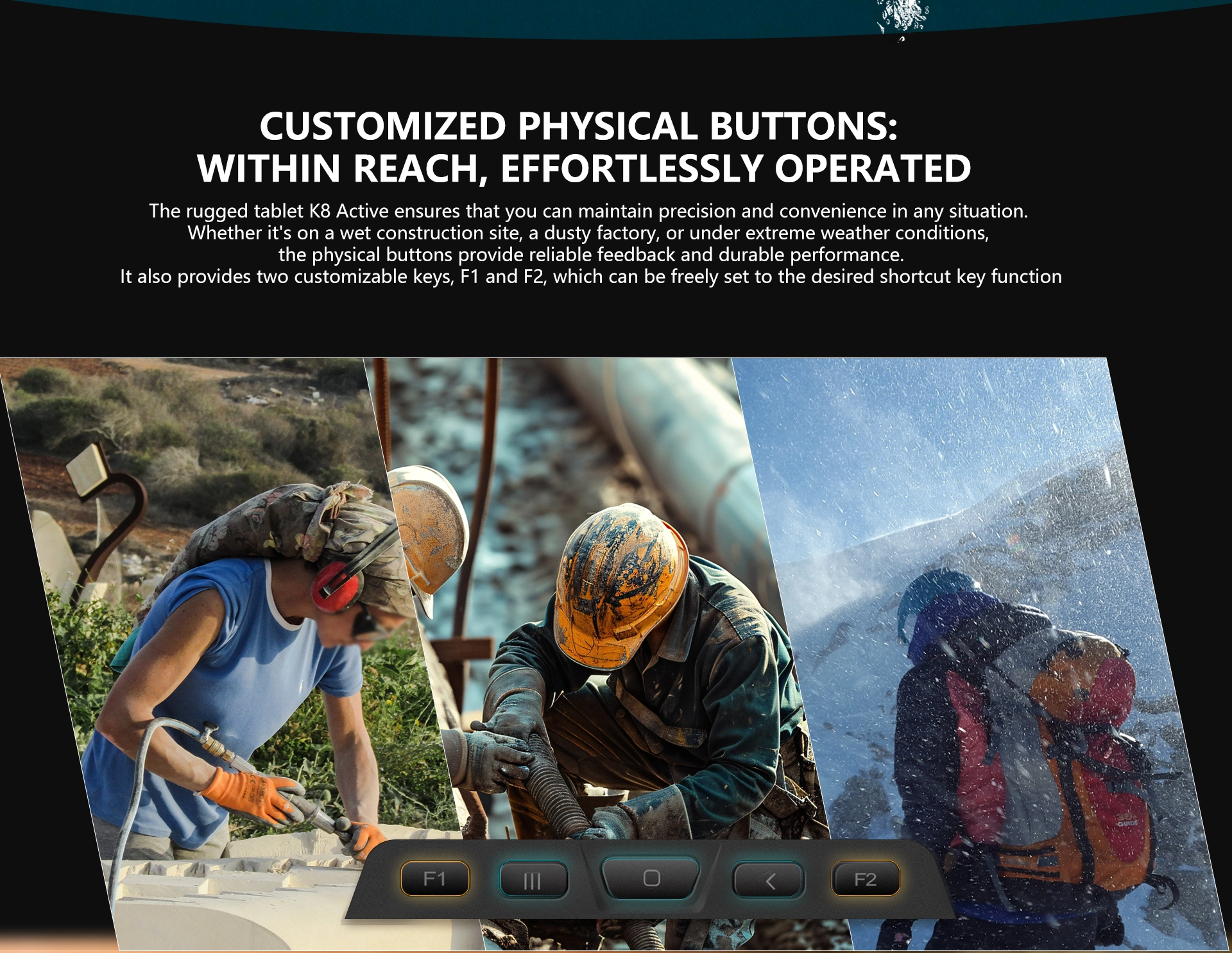
User Interface Adaptation:Customizable buttons, sunlight-readable screens, and simplified menus help workers focus on tasks instead of troubleshooting.
To appreciate rugged tablets fully, let’s compare them directly to consumer models.
| Feature | Rugged Tablets | Consumer Tablets |
|---|---|---|
| Durability | Drop, dust, and waterproof certified | Minimal resistance |
| Operating Temperature | -20°C to +60°C typical | 0°C to +35°C |
| Connectivity | LTE, GPS, industrial ports | Wi-Fi, USB-C only |
| Battery Options | Hot-swap, extended packs | Fixed internal |
| Target Use Case | Field operations, industries, military | Entertainment, office use |
Rugged tablets for the most extreme environments are not luxury gadgets—they are mission-critical tools. From the freezing poles to scorching deserts, these devices empower industries to operate efficiently, safely, and reliably where consumer electronics fail. Their durability, connectivity, and usability make them indispensable for professionals who simply cannot afford downtime. As extreme work environments continue to expand, rugged tablets will remain at the core of digital transformation in the field.
1: What is the main difference between rugged tablets and standard tablets?
Rugged tablets are designed for durability, with military and industrial certifications, while standard tablets prioritize slim designs and consumer usability.
2: Can rugged tablets survive being submerged in water?
Many models with IP67 or IP68 ratings can handle immersion for short durations, making them ideal for marine or rainy environments.
3: Are rugged tablets heavier than consumer tablets?
Yes, rugged tablets are usually heavier due to reinforced housings and larger batteries, but ergonomic designs minimize fatigue.
4: Do rugged tablets support the same software as consumer tablets?
Most rugged tablets run on Windows or Android, fully compatible with industry apps while adding extra security and connectivity features.
5: Who should invest in rugged tablets?
Organizations operating in construction, military, logistics, oil & gas, and emergency services should consider rugged tablets for reliability and safety.


