


Views: 312 Author: Site Editor Publish Time: 2026-01-01 Origin: Site


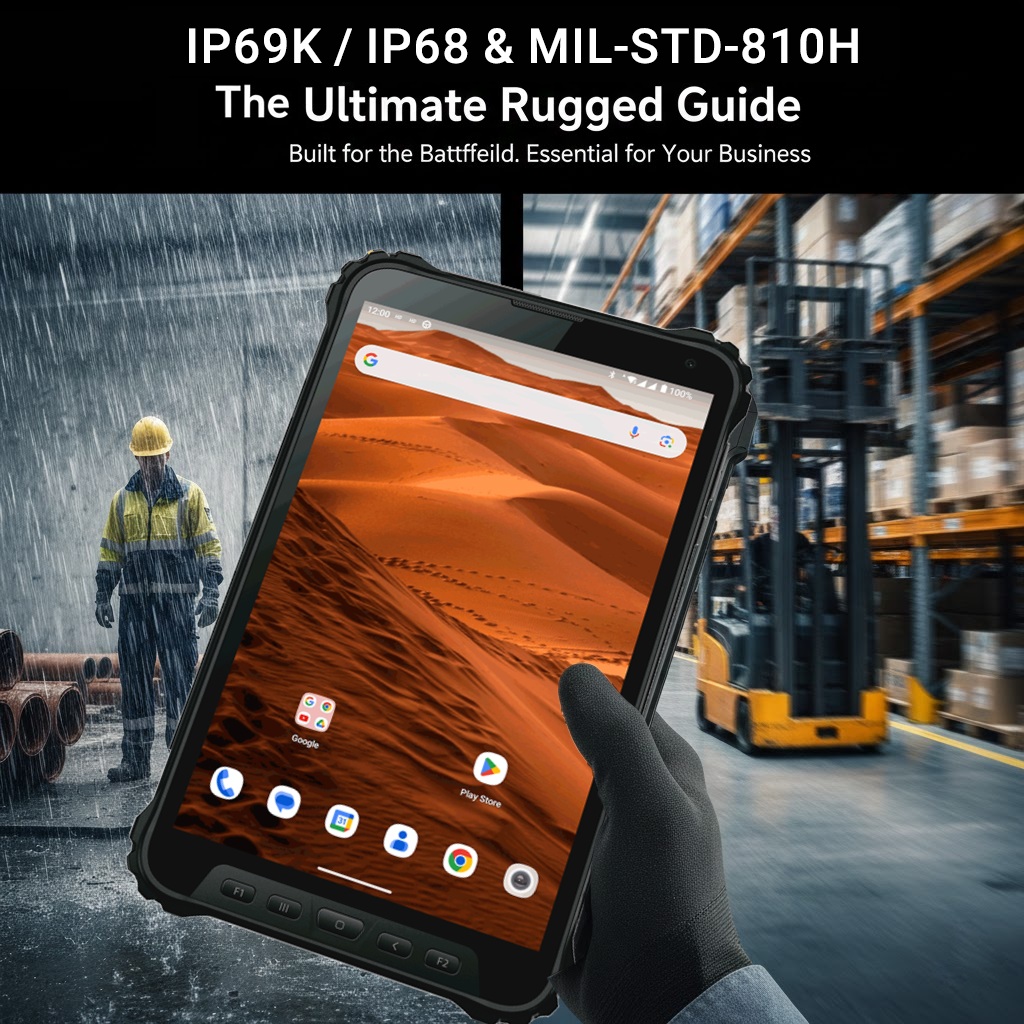
If you’ve ever shopped for industrial hardware, you’ve likely seen the terms IP68 and MIL-STD-810H splashed across spec sheets. But in the real world—on a dusty construction site in Texas or a high-humidity distribution center in Florida—what do these codes actually mean for your bottom line?
At Aozora Wireless, we believe that "rugged" shouldn't be a marketing buzzword. It should be a guarantee of operational uptime. Here is your practical guide to understanding these ratings and why they are mission-critical for your business.
"IP" stands for Ingress Protection. This rating tells you exactly how much "interference" (dust and liquids) can penetrate your device's housing.
The First Digit (6): This is the highest possible rating for solids. It means the device is dust-tight. No sand, grit, or fine particulates can enter the internal circuitry, preventing micro-scratches and short circuits.
The Second Digit (8): This refers to water immersion. While an "IP67" device can survive a brief drop in a puddle, an IP68-rated device like the K8 Active can be fully submerged in water (typically up to 1.5 meters for 30 minutes) and remain fully functional.
Why it matters: If your team works outdoors in the rain or in wash-down environments, IP68 is the difference between a minor incident and a $1,000 replacement cost.
Unlike IP ratings, which focus on seals, MIL-STD-810H is a US Military Standard that tests a device’s structural limits against environmental stress. The "H" denotes the latest, most rigorous revision of these tests.
To earn this rating, devices like our rugged tablets undergo a "torture test" that includes:
Drop Tests: Surviving multiple falls from 5 feet onto concrete.
Vibration: Withstanding constant mechanical shaking (essential for devices mounted on forklifts, vibration-heavy machinery, or long-haul trucks).
Extreme Temperatures: Operating reliably in freezing conditions (-20°C) and blistering heat (+60°C).
Shock Resistance: Ensuring the internal components stay seated even during sudden impacts.
The Practical Benefit: MIL-STD-810H means your hardware won't "shake to death" on a vibrating engine or shatter the first time it slips from a worker’s hand during a fast-paced shift.
While IP68 and MIL-STD-810H protect the shell of the tablet, the 14-pin rear Pogo Pin on the K8 Active protects the longevity of the system.
Standard tablets often fail because their USB-C ports wear out from thousands of cycles of plugging/unplugging scanners or chargers. By using the integrated 14-pin Pogo Pin interface, you can:
Attach professional modules (like high-speed scanners) directly to the rear without fragile cables.
Ensure a "vibration-proof" connection that won't snap or lose data contact if the device is jarred.
Maintain the IP68 seal permanently, as you don't need to frequently open rubber port flaps which can tear or fail over time.
Many procurement officers make the mistake of focusing only on the initial purchase price. However, for enterprise operations, the true metric is Total Cost of Ownership (TCO).
| Feature | Consumer Tablet | K8 Active (Rugged) |
| Drop Survival | Low (requires bulky, third-party cases) | Native (MIL-STD-810H) |
| Annual Failure Rate | High (typically 18-25%) | Low (typically <4%) |
| Connectivity | Dongles/Bluetooth (unreliable) | 14-Pin Rear Pogo Pin |
| Device Lifespan | 12-18 Months | 3-5 Years |
Investing in IP68 and MIL-STD-810H technology isn't about buying "over-spec" gear—it’s about ensuring your crew stays productive from the first minute of the shift to the last.
Whether you are managing a fleet of vehicles across the Midwest or a busy port on the coast, your hardware should be the last thing you worry about.
Ready to upgrade your field technology? Explore theK8 Active Rugged Tabletand discover how our 14-pin Pogo Pin system provides the ultimate professional edge.


