

Views: 432 Author: Site Editor Publish Time: 2026-07-08 Origin: Site


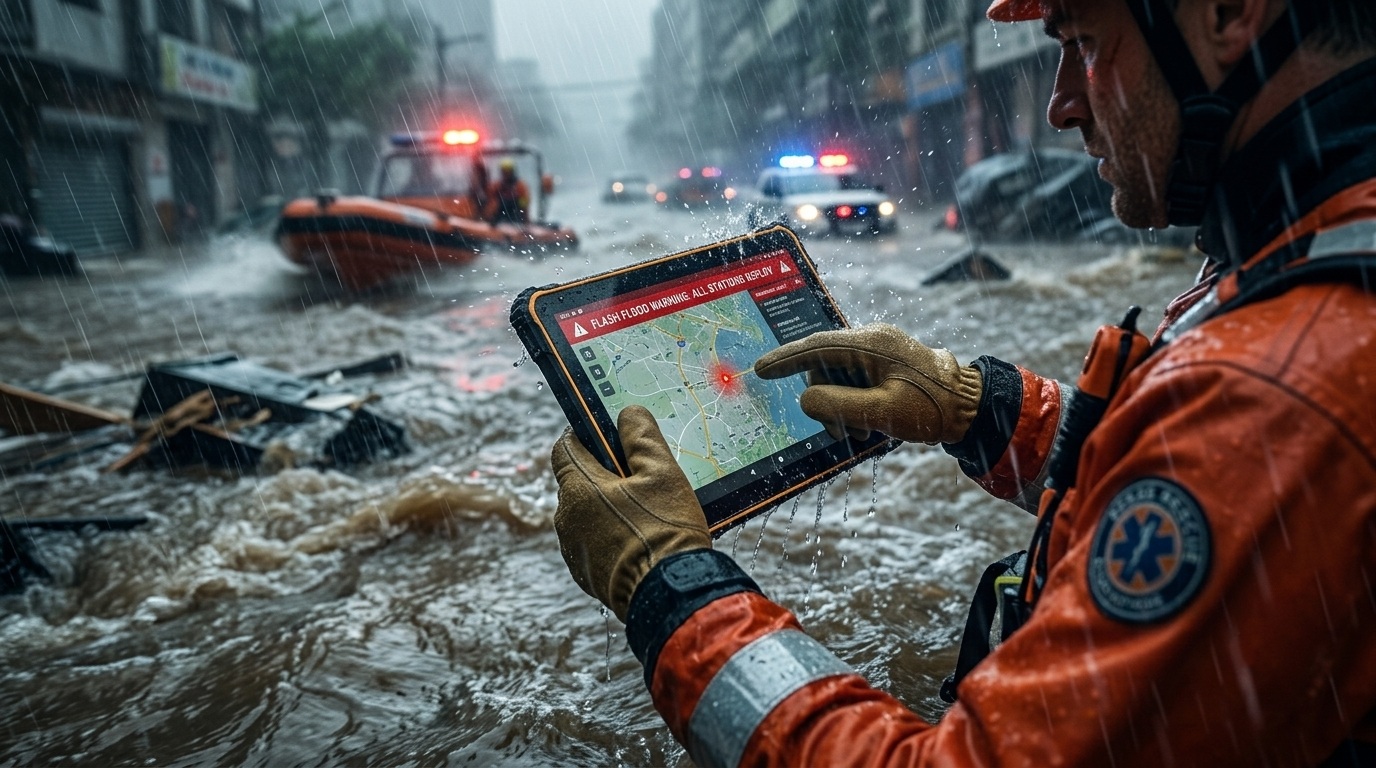
Your phone weather app flashes a sudden alert: Flash Flood Warning in this area. Move to higher ground.
For local residents, it means staying inside. For utility crews, emergency responders, and field engineers, it means the real work just started. You have to head right into the storm to check grid infrastructure, manage pump stations, or coordinate rescue logistics.
Here's the thing. If your field teams are carrying standard consumer tablets protected by plastic retail cases, you are risking total communication blackout. When the sky opens up and inches of water dump down in minutes, consumer-grade hardware fails fast. Even devices boasting basic water resistance can't cope with the brutal reality of an actual field emergency.
When infrastructure crumbles, communication is your only lifeline. You don't just need a device that survives a splash; you need an industrial rugged tablet built for the worst-case scenario.
Direct Answer: Standard IP68 ratings only certify a device for static water immersion under controlled lab conditions. They do not account for high-pressure driving rain, moving mud, or physical impacts that compromise internal seals during real-world flash floods.
Many field managers look at a retail tablet specification sheet, see "IP68 certified," and figure it's safe for field deployment. That is a dangerous assumption.
An IP68 rating means the device sat in quiet, still water at a specific depth for about 30 minutes. It doesn't mean it can handle a furious, real-world storm. In a flash flood, rain isn't static. It's driving sideways at high velocity. Mud, grit, and debris hit the chassis constantly.
Worse yet, if a worker drops that consumer device onto gravel before it slides into a puddle, the micro-cracks in the casing immediately ruin the factory seal. Water rushes right into the motherboard.
To withstand emergency field environments, you need to look beyond standard IP ratings. Look for the IP69K rating. Devices tested to this standard endure high-pressure, hot-water washing and severe jet streams from all angles. When a storm turns a job site into a mud bath, an IP69K-rated Android rugged tablet keeps running because its physical barriers are engineered for dynamic force, not just static pools.
Direct Answer: Water drops on standard capacitive screens mimic human touch, causing uncontrollable "ghost touches" or freezing the display. True industrial rugged tablets use specialized wet-hand tracking and glove-mode firmware to ensure flawless touch response in pouring rain.
Picture this scenario. A water utility technician needs to shut down a failing valve during a torrential downpour. They pull out the team tablet to look at the pressure schematics. But the screen is completely covered in raindrops.
Every single drop acts like a human finger on a standard screen. The display starts jumping wildly from app to app, opening menus randomly, or locking up completely. The technician tries to wipe it dry with a soaked sleeve, but it makes things worse. They can't input the command. Time is lost, and the damage spreads.
This nightmare disappears with proper industrial engineering. Our K8 Active rugged tablet features an 8-inch, 600-nit high-brightness display integrated with advanced wet-hand tracking and a dedicated glove mode. The internal digitizer filters out the electrical capacitance of standing water drops. It only registers the deliberate press of an operator's finger or heavy work glove. The screen stays completely readable under direct sunlight or blinding rain, ensuring commands go through on the first tap.
Direct Answer: Power grids fail during major floods, making device charging impossible for days. A rugged tablet with a massive 10,200mAh battery provides the critical multi-day runtime needed to maintain field communications throughout an entire emergency response cycle.
Flash floods don't just mess up electronics; they knock out the local power grid. Transformers blow, charging stations go dark, and trucks run out of fuel to idle their engines just to top off mobile devices.
If your field tech relies on a tablet with a standard 4,000mAh or 5,000mAh battery, you have about four to six hours of continuous map usage and data transmission before the screen goes black. In the middle of an emergency, searching for an outlet isn't an option.
Field teams need sustained power to handle continuous tracking, cellular pinging, and brightness maxed out to fight storm gloom. The K8 Active solves this with a built-in 10,200mAh battery. This massive cell keeps the 4G LTE radio and internal GPS functional through extended shifts without needing a midday recharge. When the local infrastructure fails, your device keeps processing data, mapping routes, and sending updates back to command center.
Direct Answer: Wet hands make tools slick. While consumer devices break internally from a single drop onto concrete, MIL-STD-810H certified tablets survive repeated falls into rock and mud without cracking or breaking internal connections.
Rain makes everything slippery. Tools, truck steps, and equipment casings get covered in grease and water. When an operator is rushing to respond to a flash flood warning, a device will get dropped. It might tumble from a wet hand onto jagged riprap, or plunge straight into a pool of gritty silt.
A consumer tablet inside a thick rubber case might look protected, but the internal shock is what kills it. The impact breaks delicate solder joints on the circuit board or shatters the internal display layers.
An industrial rugged tablet is built from the inside out to absorb these exact forces. Meeting MIL-STD-810H standards means the physical chassis, internal mounting brackets, and reinforced corner bumpers are vibration-tested and drop-tested repeatedly onto hard surfaces. If the K8 Active slips from an operator's grasp into a rocky drainage ditch, you pick it up, wipe off the mud, and keep working.
The bottom line is simple. Emergency situations expose the hidden weaknesses of your technology deployment. Relying on fragile devices wrapped in aftermarket cases is a liability when dealing with flash floods, heavy storms, or remote industrial sites.
Your crews need specialized tools designed for harsh environments. They need reliable 4G LTE data to stay in contact with dispatch, a bright screen that ignores water droplets, and rugged hardware that won't crack under pressure.
On the back of the K8 Active, a heavy-duty 14-pin pogo pin extension offers direct hardware expandability for secure vehicle docks or external sensors, keeping connections secure even when things get violent.
Don't wait for the next severe weather warning to find out your mobile tech can't handle the rain. Equip your team with field-proven hardware built for real-world survival.
Explore the full specifications of the K8 Active rugged tablet and see how it protects your field operations.


