

Views: 332 Author: Site Editor Publish Time: 2026-06-03 Origin: Site


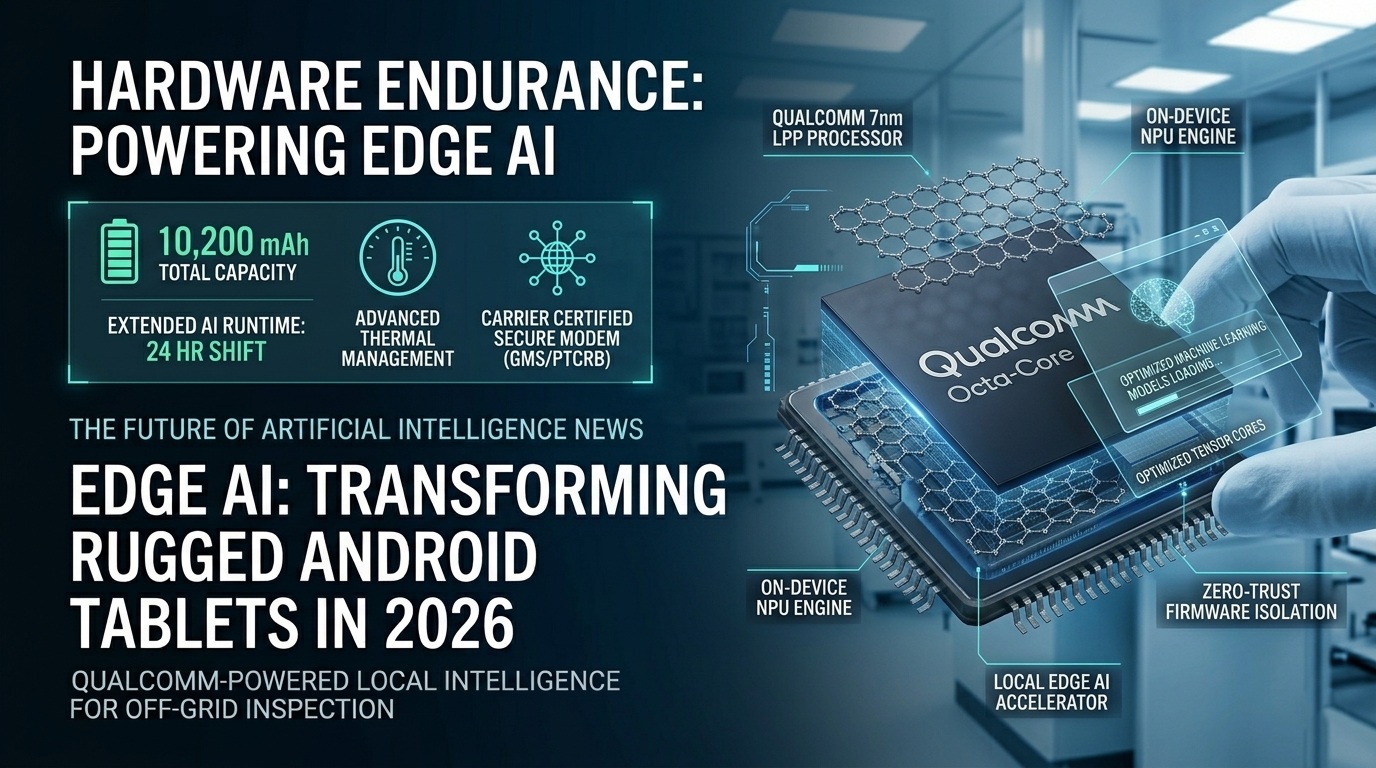
Open up any tech feed today and you will find non-stop artificial intelligence news about massive LLMs, surging AI stocks, and multi-billion dollar data centers. But out on an offshore oil rig, inside a remote power substation, or across a dark rail yard, that cloud-centric AI hype falls flat. When you have zero bars of cellular service, a cloud-dependent AI application is completely useless.
The true shift happening right now isn't in the cloud. It is at the edge.
For field operations, waiting for a tablet to upload a 4G video stream to a distant server to detect a gas leak or a faulty bearing takes too much time and consumes too much bandwidth. It exposes your operation to connectivity dropouts.
Enterprise teams are shifting to on-device processing. By running lightweight, optimized computer vision and machine learning models directly on the hardware, an Android rugged tablet becomes an intelligent field partner that works anywhere—completely disconnected from the internet.
Direct Answer Block: On-device Edge AI uses specialized neural processing blocks on mobile processors to run machine learning models directly on the hardware local storage. This eliminates cloud latency, cuts data transmission costs, and ensures continuous automated inspection in zero-connectivity environments.
To run real-time image recognition or predictive maintenance algorithms locally, standard consumer hardware won't cut it. They thermal throttle and drain their batteries within an hour under heavy computational loads.
[ Field Sensor / Camera ] ──> [ Qualcomm Octa-Core Processor ] ──> [ Local NPU Inference ] ──> [ Instant On-Screen Alert ]
                                        ▲
                                        │ (Zero Cellular Signal Required)
                               [ Local Tensor Model ]
The Aozora K8 Active relies on an enterprise-grade Qualcomm Octa-Core platform engineered to handle continuous edge computing workloads. Instead of sending raw data over the airwaves, the local hardware architecture takes the strain:
Dedicated Compute Units: The Qualcomm processor allocates specific tasks to its graphics and digital signal processing cores, allowing neural network models to execute calculations in milliseconds.
Efficient Memory Pathways: High-speed internal LPDDR4X memory ensures that real-time video frames feed into the AI model instantly without freezing the user interface.
Thermal Endurance: Unlike consumer devices that drop performance when they get warm, industrial rugged hardware uses thick internal heat-dissipation plates to maintain peak processing speeds during long field shifts.
Let's look at a concrete field scenario. A utility technician is conducting a midnight inspection at a remote water treatment facility. The site has no cellular coverage from any carrier, and there is no ambient light.
With legacy equipment, the technician takes photos in the dark, drives back to the office, uploads them, and waits for a supervisor or an automated system to flag structural defects or valve leaks the next morning. If there is a critical failure, they find out hours too late.
The K8 Active changes this dynamic by combining local computational power with an integrated 20MP infrared night vision camera.
┌─────────────────────────────────┐
│               LOCAL INSPECTION WORKFLOW     │
├─────────────────────────────────┤
│ [20MP IR Camera] ──> Captures crisp thermal/IR frames │
│         │                       │
│         ▼                       │
│ [Edge AI Model]  ──> Runs local object identification │
│         │                       │
│         ▼                       │
│ [Immediate Output]─> Flags corrosion, alignment errors  │
└─────────────────────────────────┘
The camera captures crisp images in total darkness using built-in infrared emitters. As the technician sweeps the tablet across the facility infrastructure, a local computer vision model analyzes the live video feed frame-by-frame. It flags rust, misaligned mechanical linkages, or structural anomalies instantly on the screen.
No connection to a server. No waiting for a cloud response. The tablet processes the entire workflow locally, inside the device enclosure.
Running local AI models requires hardware that can survive the environments where these insights are needed. If a tablet cracks from a minor drop or shuts down due to a dusty environment, your smart automated workflows stop instantly.
The Aozora K8 Active backs up its internal processing power with verified, industrial-grade durability:
Massive Power Capacity: Running local AI models demands more power than basic data entry. The 10,200 mAh battery provides the necessary juice to run heavy computational models alongside active camera systems for an entire shift.
Industrial Connectivity Integration: The 14-pin pogo pin interface on the back allows the tablet to secure firmly into service vehicle cradles. It interfaces directly with physical diagnostic tools, feeding telemetry data straight into the local AI engine.
Environmental Sealing: With IP68 and IP69K certifications, the device operates seamlessly in driving rain, dust storms, and heavy mud yards. The internal electronics remain protected, ensuring your edge models keep running.
Carrier Resilience: When networks are available, the PTCRB-certified 4G LTE modem ensures your local AI insights sync back to corporate databases over AT&T, Verizon, or T-Mobile infrastructure without communication errors.
The bottom line is straightforward: stop relying entirely on the cloud for your field intelligence. By deploying an Android rugged tablet equipped with an optimized Qualcomm processor and specialized night-vision optics, you give your crews the ability to analyze, diagnose, and solve problems right on the spot—regardless of how remote the job site is.


