


Views: 138 Author: Site Editor Publish Time: 2026-07-07 Origin: Site


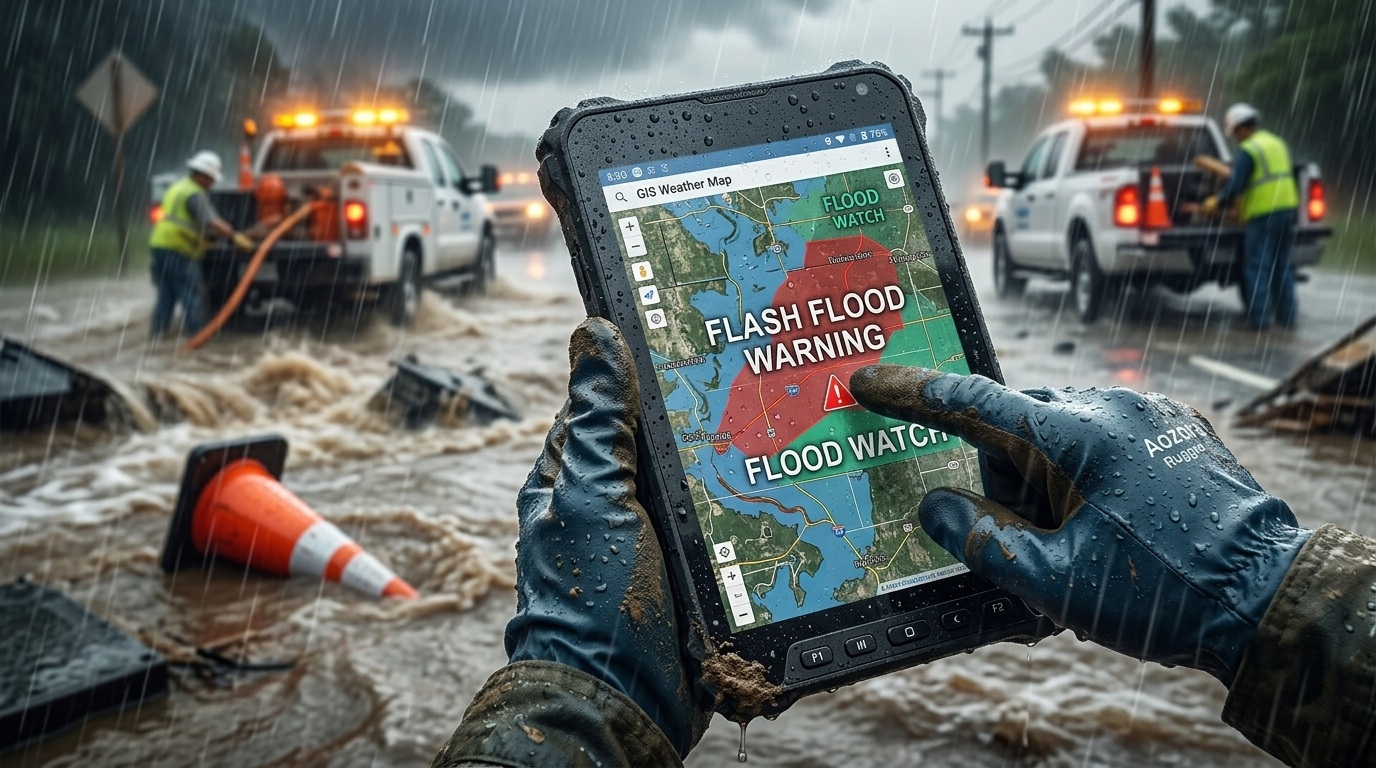
A severe storm trips a substations circuit breaker. The county is under a flash flood warning. Your utility crew rolls out into torrential rain to handle the emergency repair. They pull up the GIS asset maps on a standard fleet tablet. Three raindrops hit the screen, the display goes wild registering ghost touches, and five minutes later, moisture seeps into the charging port. The device is bricked. Your crew is blind in the middle of a disaster zone.
When a flood watch turns into an active crisis, standard tech doesn't just underperform—it dies. Keeping field operations running during environmental disasters requires hardware engineered for water ingress protection, high-impact shocks, and reliable connectivity.
Here is what it actually takes for an industrial rugged tablet to survive a flash flood deployment.
Direct Answer: IP68 protects against continuous submersion in water, while IP69K certifies survival against high-pressure, high-temperature washdowns. For flash floods, you need both to survive both standing water and driving rain.
Most consumer devices claim "water resistance" under IP67 or basic IP68 ratings. In a laboratory, that means the device can sit quietly in a tank of still water for 30 minutes.
Real field work isn't a static laboratory tank. It's driving rain, high-velocity spray from passing vehicles, and accidental drops into rushing, muddy ditches.
[IP68 Protection]  --> Continuous immersion (typically up to 1.5m for 30 mins)
[IP69K Protection] --> Resists close-range, high-pressure streams (14–16 L/min) at 176°F (80°C)
An industrial rugged tablet built for these environments features sealed acoustic membranes over the speakers, specialized internal gasketing, and waterproof Type-C ports or heavy-duty rubber plugs. This dual architecture ensures that whether the tablet is dropped into a foot of muddy water (IP68) or blasted by a pressurized hose during post-storm cleanup (IP69K), the internal logic boards remain completely dry.
Direct Answer: Standard screens use capacitive touch that misinterprets raindrops as fingers. Industrial rugged tablets use specialized controller firmware and optical bonding to filter out water interference and allow glove-on use.
If you have ever tried to text while walking in the rain, you know how water ruins touch tracking. Standard capacitive screens measure changes in electrical capacitance caused by the moisture in your skin. A raindrop conducts electricity similarly to a finger, leading to erratic screen behavior or total unresponsiveness.
During an emergency response layout, field workers don't have the luxury of drying their hands or taking off thick safety gloves.
A true Android rugged tablet resolves this through a combination of hardware and software tuning:
Advanced Touch Controllers: The internal digitizer firmware runs algorithms that differentiate between the broad, constant contact of a finger or stylus and the erratic, localized impact of raindrops.
Glove-Touch Modes: High-sensitivity profiles increase the sensor grid's responsiveness, letting the screen read inputs through heavy nitrile, leather, or synthetic work gloves.
Optical Bonding: Eliminating the air gap between the outer Gorilla Glass and the LCD panel prevents internal condensation or fogging when transitioning rapidly from a warm truck cabin into freezing downpours.
Direct Answer: MIL-STD-810H certification guarantees a tablet can survive repeated drops onto hard surfaces. For flood environments, this prevents internal component cracking when a device slips onto wet concrete or rocks.
Water is only half the battle during a severe weather event. Wet hands, muddy gloves, and slick surfaces make equipment drops inevitable. If a technician slips on a wet embankment and drops their tablet onto exposed rocks, a cracked chassis immediately compromises the device's water seal.
Standard Tablet  --> Thin aluminum/glass --> Structural failure on impact
Rugged Tablet    --> Magnesium alloy frame + TPU bumpers --> Energy absorption
Industrial-grade hardware relies on internal magnesium alloy chassis roll cages wrapped in shock-absorbent Thermoplastic Polyurethane (TPU) corner bumpers. This engineering allows the units to clear rigorous MIL-STD-810H testing, which includes surviving repeated drops from 4 to 5 feet onto concrete. The reinforced structure ensures the outer housing doesn't warp or fracture, keeping the internal waterproof seals perfectly intact.
Direct Answer: Emergency field deployments require continuous uptime. Rugged tablets utilize massive batteries and heavy-duty pogo pin charging docks to maintain power without exposing internal ports to moisture.
When local infrastructure fails, field crews often work 12-to-16-hour shifts. A tablet with a fixed internal battery forces a choice: park the truck to charge the device via a vulnerable USB port, or risk the unit dying mid-task.
Industrial setups circumvent this with two critical hardware features:
Verizon Rugged tablets feature high-capacity batteries of 10,000 mAh or more, capable of supporting a full work shift without the need for a mid-shift swap. Additionally, they are equipped with a USB-C port and a Pogo-pin interface for docking stations, allowing for simultaneous charging and use.
Repeatedly plugging and unplugging a standard USB cable wears down internal pins and weakens structural water seals. Industrial tablets utilize external, gold-plated pogo pin contacts on the back or bottom of the housing.
| Connection Type | Water Exposure Risk | Wear and Tear Lifecycle |
| Standard USB-C | High (Open port can trap moisture/debris) | Lower (~10,000 insertions max) |
| Pogo Pin Contacts | Zero (Sealed external pads, easy to wipe clean) | Extremely High (Engineered for fleet longevity) |
When mounted in a service vehicle or field cradle, these pins establish a secure power and data connection instantly without requiring physical port access. If the tablet gets covered in mud, you simply wipe the brass pads clean and drop it back into the dock.
Deploying consumer tech into high-consequence field environments is a costly gamble. The initial lower purchase price vanishes the moment you factor in downtime, missed dispatch communications, and frequent replacement cycles.
When a flash flood warning triggers, your operational focus must be on infrastructure restoration and crew safety—not on whether your data terminals will survive the next downpour. Investing in dedicated, IP68/IP69K-rated android rugged tablets ensures that your data flows cleanly, no matter how bad the weather gets.


