

Views: 184 Author: Site Editor Publish Time: 2026-07-15 Origin: Site


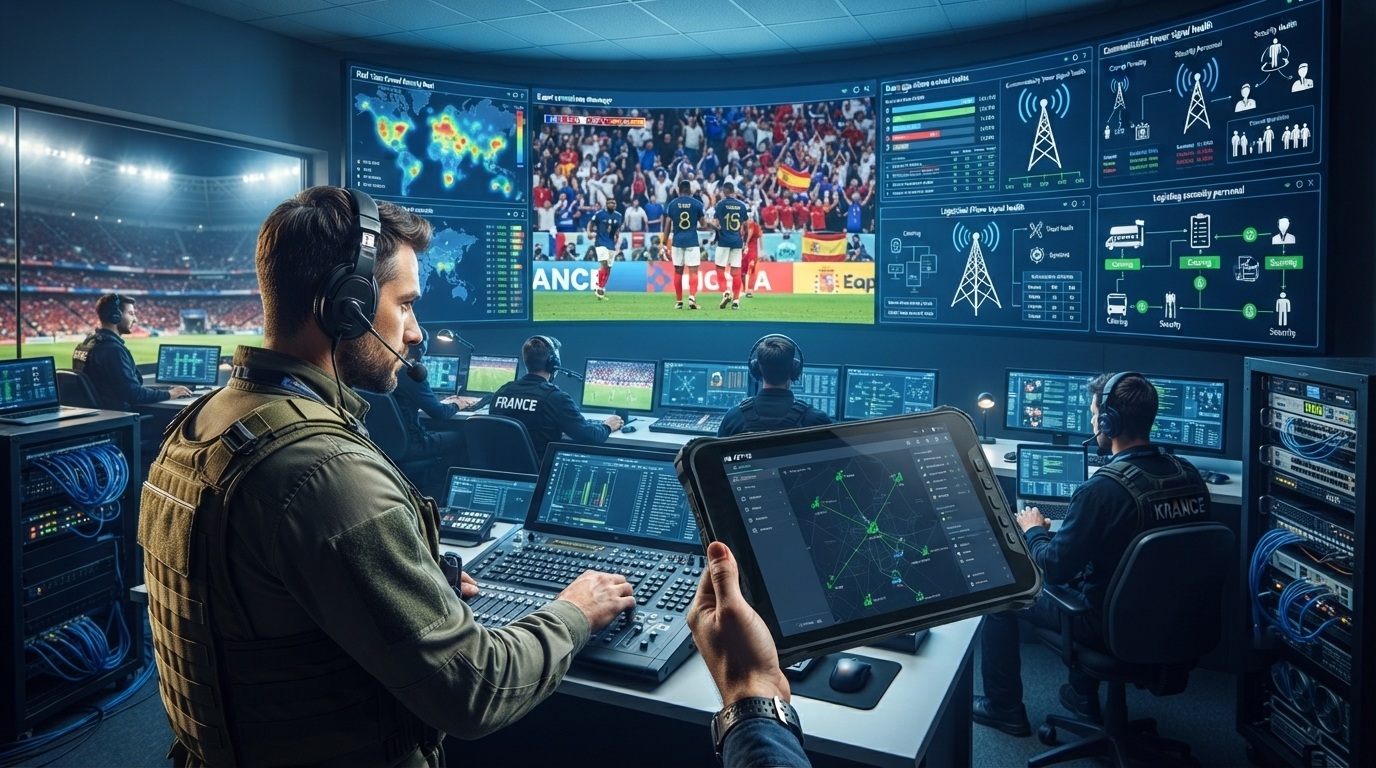
Everyone's talking about the big match. Whether you're cheering for France or Spain, the energy is electric.
But when 80,000 fans pack into a stadium, or a marathon shuts down a city center, have you ever stopped to wonder what actually keeps that event running?
It's not just about the athletes on the field or the performers on stage. It's about the invisible infrastructure. The split-second communication. The real-time logistics.
It's the communication "neural network." And here's the reality: consumer-grade Wi-Fi and your personal smartphone simply cannot handle that kind of pressure.
The Direct Answer: In a major event, network failure isn't an option. It's a safety risk. That's why operations teams rely on hardened industrial hardware.
Think about the logistics manager trying to coordinate security staff across five different entry gates. Or the broadcast team needing to stream high-definition video feeds from the sidelines to the production truck without a single dropped frame.
If the Wi-Fi goes down at a coffee shop, it's annoying. If the network fails during a live event opener? You lose money, and you jeopardize public safety.
This is the environment where we operate. Aozora Wireless provides the hardened gear that connects these high-stress nerve centers.
Large-scale event operations demand two things that consumer devices cannot provide: guaranteed bandwidth and zero-latency communication.
When a stadium fills up with tens of thousands of people, every commercial cellular network in the area gets instantly saturated. Everyone is trying to upload photos and stream videos.
Here's the bottleneck: Consumer modems in routers or standard phones will prioritize consumer traffic. An operations manager's urgent call about a medical emergency can get dropped in favor of someone posting an Instagram story.
Industrial hardware is different. We deploy industrial cellular routers equipped with advanced band-locking capabilities. We can lock the device onto a specific, less-congested band, or even bond multiple cellular connections together to guarantee a massive, dedicated pipeline for operational data only.
It's not just the routers in the command tent. It's the gear in the hands of the staff.
The Situation: A delivery truck is trying to navigate through a dense crowd to restock a concession stand. The driver is using a rugged handheld terminal.
This device needs to scan inventory, confirm delivery, and communicate the driver's location to central dispatch. A consumer tablet dropped on the concrete floor of a stadium concourse during this process would shatter.
Our industrial rugged tablets are built for this exact scenario. They are encased in shock-absorbent materials, rated to withstand multiple drops onto concrete, and crucially, they feature sunlight-readable displays. If a staff member can't read the screen in direct midday sun, the device is useless.
Why does Aozora Wireless focus on this extreme reliability? Because the challenges faced by a stadium operations manager are identical to the challenges faced by a logistics manager in a massive, automated warehouse.
Just like a stadium, a modern distribution center is a complex ecosystem of moving parts. Forklift operators are scanning pallets. Automated guided vehicles (AGVs) are navigating aisles. Every node in this network must be connected, constantly.
A single second of network latency in an automated facility can cause a collision or a system-wide shutdown. Our industrial hardware is tested to MIL-STD-810H standards to survive the vibration, dust, and temperature fluctuations of these industrial environments.
Whether you're managing the logistics for a global sporting event or running a 24/7 e-commerce fulfillment center, the principle is the same: your technology must be as tough as the environment you operate in.
Fragile gear is a liability. Hardened, industrial-grade infrastructure is an investment in operational continuity.
We've compiled a technical brief on how we engineer our systems to maintain high-bandwidth, low-latency connections in the most challenging scenarios imaginable.
See how the pros keep the data flowing, even when the pressure is on.
What's the biggest communication challenge you face during large-scale, temporary operations? Tell us in the comments below.


