

Views: 468 Author: Site Editor Publish Time: 2026-06-08 Origin: Site


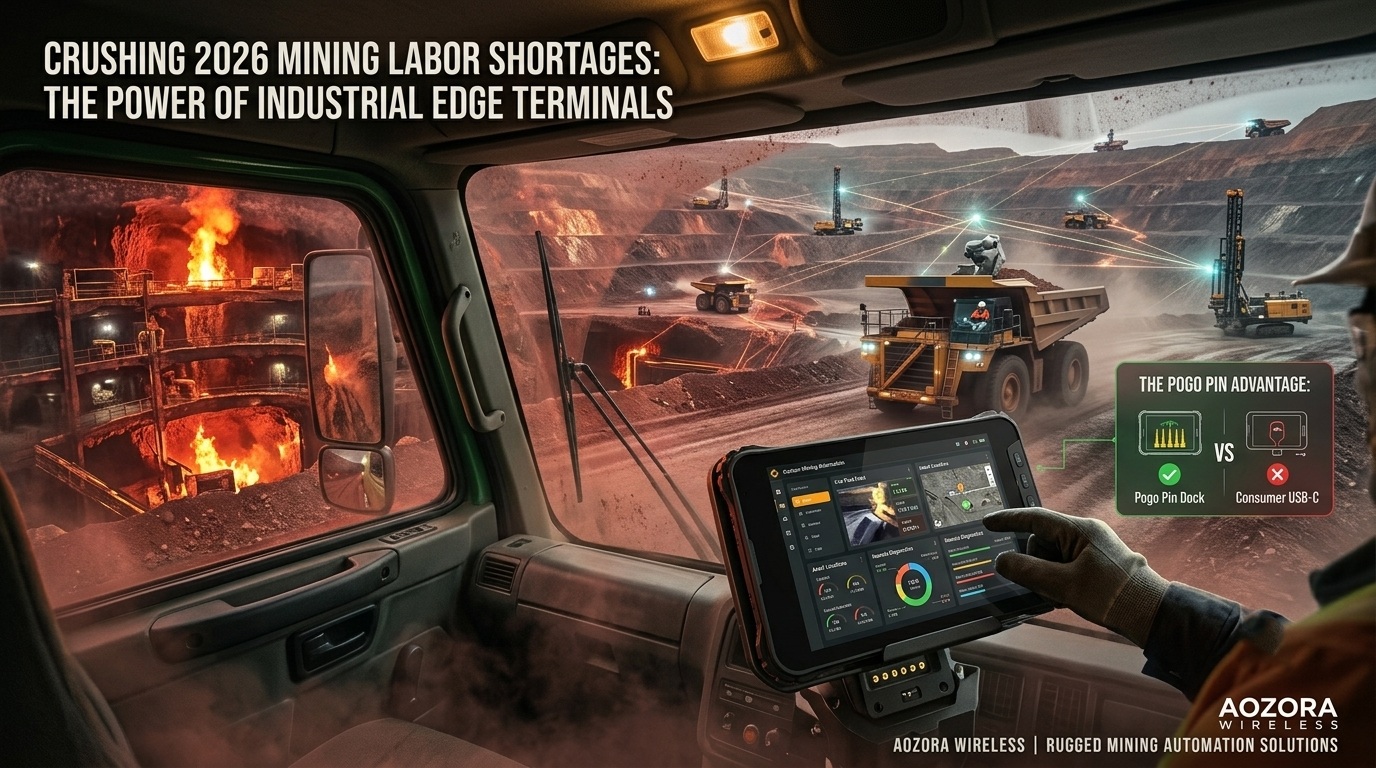
The global mining industry has hit a wall. Across Western Australia, Nevada, Arizona, and Northern Canada, mining operations face a twin crisis: tier-one deposits are getting deeper, and the skilled labor pool is drying up. According to 2026 mining resource trends, finding experienced haul truck operators and heavy equipment technicians has never been more difficult or expensive.
To maintain production quotas for copper, gold, and lithium, operators cannot rely on throwing more bodies at the problem. The goal has shifted toward driving up per-worker efficiency. If you want to maximize asset utilization, your operators need reliable, uninterrupted data lines directly inside their cabs.
Direct Answer: Deep underground and open-pit mining operations are scaling up automation to counter a severe labor deficit. When fewer workers manage larger fleets of automated drill rigs and haul trucks, a single terminal failure ripples through the entire site, causing massive downtime.
As easy-to-reach ore bodies deplete, mines are forced to dig deeper tunnels and manage massive open pits. These environments are unforgiving. Underground industrial comms must contend with damp rock faces, high ambient heat, and heavy machinery that shakes the ground constantly.
With headcounts dropping, single operators are now managing multiple automated drill rigs or monitoring autonomous haulage systems (AHS) remotely from a vehicle cab.
Think about the workflow: an operator relies on a tablet to track telemetry, dispatch commands, and view payloads. If that tablet fails because it cannot handle pit vibrations or high temperatures, an entire production sector grinds to a halt. In 2026, terminal reliability is synonymous with site productivity.
Direct Answer: Standard USB-C connectors fail on heavy mining equipment because continuous chassis vibration shears internal pins and fine, abrasive ore dust jams the ports. Heavy-duty Pogo Pin vehicle mounts utilize spring-loaded surface contacts that resist vibration and prevent dust accumulation.
Ask any fleet maintenance manager in the Nevada desert about their biggest tech headache, and they will tell you it's broken charging cords.
When you mount a standard consumer or semi-rugged tablet into a haul truck or a dozer using a USB-C cable, you are asking for trouble. Mining trucks vibrate violently and constantly. This micro-vibration puts massive structural stress on the tiny tongue inside a USB-C port. Within weeks, the internal pins warp, causing intermittent charging or total data loss.
Then there is the dust. Abrasive iron ore, copper, or gold dust floats through the cab. It packs tight into the recess of a USB-C port every time a cable is plugged in. Eventually, the cable can't sit flush, causing electrical arcing or short circuits.
Aozora's K8 Active solves this by completely replacing vulnerable consumer ports with a gold-plated Pogo Pin interface for vehicle docking. The Verizon rugged tablet snaps onto spring-loaded copper pins on the cradle. There are no recessed cavities to trap dust, and the physical connection accommodates constant chassis shaking without wearing out.
Engineering Factor | Consumer USB-C / Lightning Connections | |
Vibration Tolerance (G-Force) | Poor (Cables wiggle free; pins fracture under continuous shock) | Excellent (Spring-loaded pins maintain solid structural contact) |
Physical Lifecycle (Mating Cycles) | ~10,000 insertions max (Degrades quickly in grit) | 60,000+ insertions (Built for multi-shift continuous fleet use) |
Dust & Particulate Defense | High Failure Risk (Grit packs inside port, blocking power) | Self-Cleaning Design (Flat surface contacts wipe clean instantly) |
Connection Speed in Vehicles | Slow (Requires manual alignment and two hands to plug in) | Instant Snap-In (One-handed drop-in docking with magnetic guide) |
Direct Answer: Aozora tablets serve as rugged automation terminals for mines by integrating high-power private 5G radios (including Band 48/CBRS and local bands). They process machine telemetry at the edge, linking directly to autonomous drill rigs and remote dispatch centers without lag.
Modern mining relies on data-heavy applications—real-time payload optimization, tire pressure monitoring, and precision GPS guidance. To run these smoothly, top-tier operators deploy private 5G LTE networks across their lease boundaries to guarantee bandwidth where public infrastructure doesn't exist.
Aozora devices are engineered specifically to act as an automation terminal for mines. They interface flawlessly with private infrastructure, allowing a lone field technician to monitor multiple automated systems simultaneously.
Whether mounted in a light utility vehicle or carried deep into an underground stope, the high-gain internal antennas keep a rock-solid link to the mine's central dispatch. Operators can make quick decisions based on real-time data, cutting out the transit delays that kill efficiency on short-handed shifts.
Haul trucks generate extreme low-frequency, high-amplitude vibrations that quickly destroy standard plug-in charging ports. A Pogo Pin vehicle mount tablet uses heavy-duty, spring-loaded pins that absorb chassis vibration, ensuring the device charges continuously and maintains data links without mechanical failure.
While consumer devices have lower initial hardware costs, their failure rates in mining environments often exceed 30% annually due to cracked screens, broken ports, and overheated batteries. Upgrading to Aozora rugged devices drops field failure rates below 2%, delivering a lower Total Cost of Ownership (TCO) by eliminating frequent replacements and heavy machinery downtime within the first 12 to 18 months.


