

Views: 462 Author: Site Editor Publish Time: 2026-06-11 Origin: Site


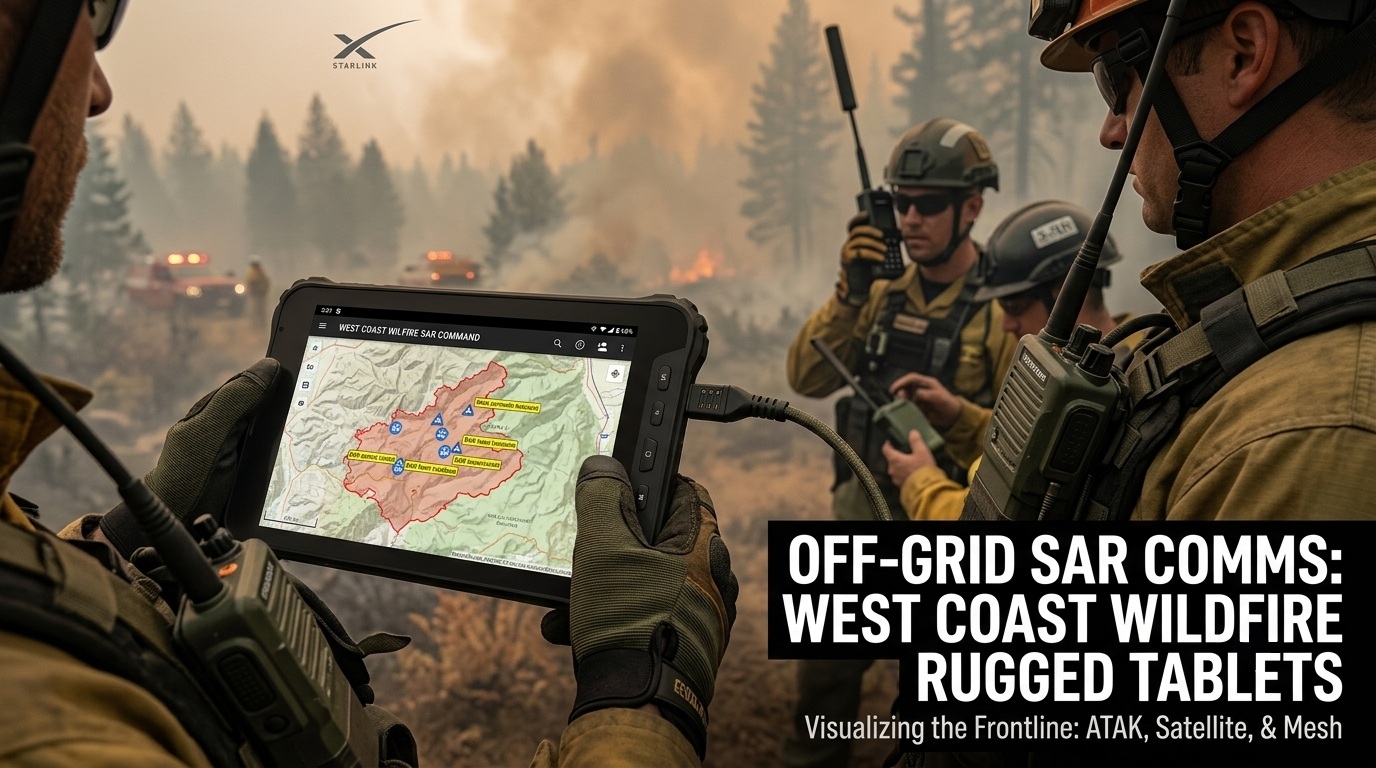
Direct Answer: Traditional communication infrastructure collapses during severe wildfires, while consumer devices experience thermal shutdown, making specialized rugged tablets essential for frontline search and rescue operations.
The 2026 wildfire tracker data shows an alarming trend across California, Oregon, and Washington: fires are moving faster, starting earlier, and burning hotter. For Pacific Northwest wildfire deployment tech 2026, the frontline environment is brutal.
When a wildfire rips through a canyon, commercial cell towers and fiber-optic backhauls are the first things to burn. Public safety cellular networks go dark instantly. Worse, the heavy smoke plummets visibility and ionizes the surrounding air, degrading standard satellite and line-of-sight radio signals.
[Wildfire Flame/Smoke] ──> Destroys Cell Towers ──> Public Network Blackout
[Extreme Heat >35°C]  ──> Consumer Tablets     ──> Thermal Shutdown (Failure)
Relying on standard commercial smartphones or tablets enclosed in plastic cases is a recipe for operational failure.
Thermal Shutdown: Consumer hardware initiates a protective thermal shutdown once ambient temperatures hit 35°C (95°F). Fire field perimeters regularly exceed this threshold. A tablet that turns into a black screen mid-operation risks lives.
Particulate Ingress: Microscopic wood ash and airborne smoke particles act as corrosive abrasives. They clog open USB-C ports, speaker grates, and headphone jacks within hours, permanently bricking internal circuitry.
Direct Answer: An industrial rugged tablet acts as a central data hub, utilizing reinforced physical and wireless interfaces to link external tactical radios, satellite terminals, and mesh networks into a unified communication system.
Search and rescue (SAR) teams do not need a tablet to act as a standalone radio. They need a mobile digital command center that aggregates data from external off-grid communication systems. The Aozora industrial rugged tablet serves exactly as this tactical hub.
Instead of relying on public cellular networks, field operators connect the tablet to dedicated tactical hardware.
┌───────────────────────────┐      ┌───────────────────┐
│ External Off-Grid Comms                        │ ───>  │  Aozora Rugged Tablet         │
│ (Starlink, goTenna, BGAN)                        │ POGO     │ (Local Data Aggregator /       │
└───────────────────────────┘ Pin     │  Command Visualizer)         │
                                   └───────────────────┘
The hardware architecture uses heavy-duty, reinforced Type-C interfaces and high-bandwidth, low-latency Bluetooth/Wi-Fi modules to maintain stable data pipelines with external peripherals. For teams requiring secure, vibration-proof physical connections, custom POGO pin configurations lock down peripheral integration without exposing raw ports to the elements.
This ecosystem allows California Cal OES compliant tactical hardware setups to bridge the gap between disparate systems. Whether pulling down situational feeds from a portable Starlink terminal, exchanging encrypted text bursts via a goTenna Pro mesh node, or hooking into a military-grade tactical radio, the tablet processes data without relying on a single cell tower. It eliminates information silos in zero-connectivity dead zones.
Direct Answer: High-performance onboard edge computing allows rugged tablets to process local data and render high-resolution offline GIS maps natively, maintaining situational awareness without active internet connections.
When you lose connection to the cloud, your tablet must rely entirely on its local processing power. The Aozora android rugged tablet is built for heavy-duty edge computing. Equipped with a high-performance multi-core processor and extensive internal storage, it handles resource-heavy data rendering locally on the fire line.
SAR teams deploy specialized emergency management platforms like ATAK (Android Tactical Assault Kit) directly on the device. Before heading into the field, operators cache massive datasets natively, including:
High-resolution vector topographic maps
Historical fire boundary lines
Oregon SAR team offline GIS mapping tablets infrastructure layouts
[Raw RF/Mesh Data Input] ──> [Onboard CPU Processing] ──> [Real-Time ATAK Display]
When connected to an external mesh node, the tablet reads incoming low-bandwidth radio frequency data and translates it visually in real time. Field commanders look at the screen and see an active, updating map layer showing the position of every team member (Position Location Information) alongside dynamic fire perimeter projections. No cloud connection required; everything computes locally.
Direct Answer: MIL-STD-810H certification guarantees operation in extreme temperatures and high-vibration environments, while specialized display technology ensures visibility under direct sunlight and responsiveness with heavy protective gloves.
Industrial operations demand hardware built to survive. Aozora tablets are fully certified to MIL-STD-810H standards, ensuring continuous operational integrity under conditions that destroy standard enterprise tech.
| Operational Requirements | Aozora Tactical Rugged Tablet | Consumer Tablet + Heavy Case |
| Peripheral Integration | Heavy-duty I/O ports and POGO pins designed for tactical radios & satellite links. | Loose USB ports; easily disconnected under vehicle or field vibration. |
| Offline Mapping Capabilities | High-performance CPU & massive storage for large-scale GIS/ATAK offline maps. | Lags, stutters, or crashes when rendering high-resolution offline map layers. |
| Thermal Performance | Continuous, unthrottled operation up to 60°C (140°F) via advanced thermal dissipation. | Triggers thermal shutdown at 35°C (95°F), rendering the device completely useless. |
| Ingress Protection | IP68 Certified; completely sealed housing against corrosive wildfire ash and dust. | Ash penetrates speaker grills and open charging ports, causing hardware failure. |
Field visibility is critical when smoke obscures the sun. The 600+ nits high-brightness, anti-glare display allows incident commanders to read dense mapping data clearly in harsh daylight or hazy environments.
Furthermore, standard capacitive screens fail when covered in ash or touched with safety gear. The Aozora display uses customized touch-filtering algorithms. This gloved-touch functionality means field personnel can accurately manipulate maps, drop waypoints, and send text alerts while wearing heavy structural firefighting or technical rescue gloves.
The tablet acts as the computational brain and visualization terminal. It connects directly via reinforced Type-C, Bluetooth, or POGO pins to external off-grid hardware such as satellite transceivers, mesh networking nodes, and tactical radios. The tablet processes the raw data streams from these devices to render real-time team positioning and mapping updates without requiring cellular service.
A California wildfire response tablet requires an IP68 ingress rating to completely seal out airborne wood ash, MIL-STD-810H certification to withstand sustained operational heat up to 60°C, a minimum 600-nit display for high-glare readability, and a glove-compatible touchscreen. It must also feature a high-performance processor to run offline GIS and ATAK software locally. An industrial Verizon tablet option ensures immediate fallback connection to public safety cellular bands when moving outside active burn zones.


