

Views: 178 Author: Site Editor Publish Time: 2026-03-30 Origin: Site


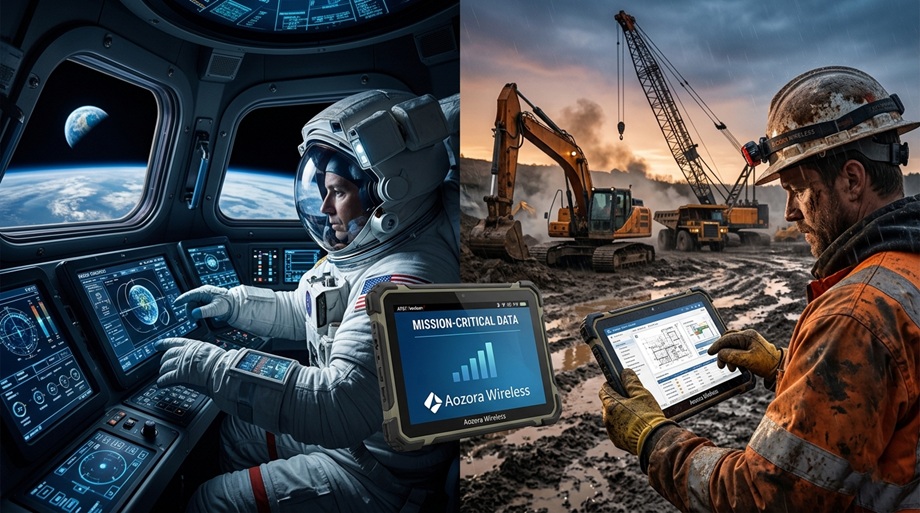
As NASA locks in the launch window for Artemis II, the world is watching the Kennedy Space Center with bated breath. This isn't just a nostalgic trip around the moon; it's the ultimate "stress test" for human communication and computing.
At Aozora Wireless, we've been thinking: Why do these astronomical standards matter for your team on the ground?
When the Orion spacecraft rips through the atmosphere, facing extreme vibration, radiation, and thermal swings, the crew relies on absolute hardware certainty. Whether you're in a deep-pit mine, a remote survey site, or a high-stakes logistics hub, your team is essentially running a "earthbound" version of a space mission.
Why does this matter? Because in the field, "good enough" usually isn't.
Direct Answer: Space-grade reliability focuses on structural integrity under high-frequency vibration. A true rugged tablet must maintain internal circuit continuity during constant mechanical stress, not just survive a one-time accidental drop.
The Artemis II crew will experience bone-shaking mechanical vibrations during the ascent phase. This mirrors exactly what Aozora customers face when mounting devices in heavy machinery, vibrating armored vehicles, or near drilling equipment.
Most consumer tablets claim to be "tough," but they haven't been built for the long haul. Our K8 Active rugged tablet strictly follows the MIL-STD-810H military standard. Here's the breakdown of what that actually means for your daily operations:
● Shock Absorption: It survives 1.5-meter drops onto concrete, but more importantly, the internal components don't "rattle" loose.
● Constant Vibration: Designed to stay mounted on a jackhammer-equipped tractor without the screen flickering or the motherboard cracking.
● Sealing: It keeps out the fine lunar-like dust found on construction sites that destroys standard charging ports.
Direct Answer: Industrial smart tablets utilize advanced heat dissipation to operate between -20°C and 60°C. This prevents the "thermal shutdown" common in consumer devices when exposed to direct sunlight or freezing cold-chain environments.
On the far side of the moon, the temperature swings are lethal. While your job site might not be that hostile, a standard iPad will brick itself in minutes if left on a truck dashboard in the Texas sun or used in a Chicago winter.
The Artemis mission uses sophisticated liquid cooling and thermal blankets. We take a similar approach with thermal engineering. Aozora Wireless terminals are optimized for Wide Operating Temperatures.
Feature | Consumer Tablet | Aozora Rugged Tablet (K8 Active) |
Operating Temp | 32°F to 95°F (0°C to 35°C) | -4°F to 140°F (-20°C to 60°C) |
Sunlight Visibility | Glossy, high glare | High-nit, anti-glare, glove-touch |
Battery Safety | Swells in high heat | Heat-resistant cells with smart BMS |
Enclosure | Plastic/Thin Aluminum | Magnesium Alloy / Reinforced Polymer |
If your hardware quits because it's "too hot," your entire workflow stops. We make sure that doesn't happen.
Direct Answer: Critical missions require a Verizon rugged tablet or AT&T rugged tablet with FirstNet Ready™ capabilities. This ensures priority access to cellular bands even when public networks are congested or unavailable.
Artemis II relies on the Deep Space Network (DSN) to talk to Houston. Back on Earth, your "deep space" might be a remote forest or a disaster zone where standard 5G is non-existent.
This is where the Aozora edge comes in. We don't just give you a SIM slot; we provide a communication lifeline. Our devices are engineered for:
● Carrier Versatility: Fully compatible as a Verizon rugged tablet or AT&T rugged tablet, allowing your fleet to switch carriers based on regional signal strength.
● FirstNet Ready™: For first responders and mission-critical teams, our hardware supports Band 14, giving you the "HOV lane" of cellular data when everyone else is blocked.
● Enhanced Antenna Gain: Better signal acquisition in fringe areas where your smartphone shows "No Service."
We've seen it happen too often: a foreman can't upload a blueprint because the site's 5G is crawling. With an Aozora device, you're using the same logic as an astronaut—always have a backup link.
Artemis II is about pushing into the unknown, while Aozora Wireless is about protecting what you've already built.
As that Orion capsule streaks across the sky, it serves as a reminder: great engineering is just a fancy word for "respecting the environment." Whether your battlefield is the vacuum of space or a dust-choked construction site, reliability is the only ticket to the game.
Don't let a "soft" tablet be the single point of failure in your multi-million dollar project.
Q: Is a thick case enough to make my tablet rugged?
A: No. A case protects the shell, but it doesn't protect the internal solder points from vibration or the battery from overheating. A true rugged tablet is engineered from the inside out.
Q: Why should I care about Verizon or AT&T certification?
A: Certified devices like ours ensure that the modem inside the tablet is optimized for the specific frequencies used by US carriers, leading to fewer dropped calls and faster data speeds in rural areas.
Explore the Aozora Rugged Lineup: See how the K8 Active sets the new industry standard


