

Views: 664 Author: Site Editor Publish Time: 2026-06-01 Origin: Site


Texas businesses remember February 2021. The grid dropped, temperatures plummeted, and hundreds of remote industrial sites went dark and silent. Today, the pressure on the North American energy grid is higher than ever. Local governments are rolling back tax breaks for massive AI data centers because these facilities consume megawatts of power faster than utility companies can build substations.
When a regional grid faces extreme summer peak loads or sudden storm damage, industrial remote sites—water treatment facilities, power substations, construction yards, and pipeline monitoring stations—face a double whammy: localized blackouts and hardline broadband failures.
If your field operations rely on standard commercial-grade routers or consumer-grade connectivity, your data streams stop the moment the local power pole falls. That is an expensive blind spot.
Direct Answer: Extreme weather and soaring data center power demands expose remote infrastructure to sudden utility blackouts and landline internet drops, halting critical operational data flows.
When a localized brownout hits a remote water treatment plant or an oil patch in West Texas, the loss of shore power kills standard fiber or DSL modems. Field operators lose visibility into SCADA systems, telemetry logs, and security feeds.
[Local Substation Failure] ──> [Standard Fiber/DSL Modems Drop] ──> [Blind Field Operations]
This is where the standard supply chain breaks down. Field technicians are left troubleshooting in the dark without access to schematics, while central dispatch loses real-time asset tracking. To maintain operational continuity during a grid emergency, your communications equipment must be independent of local wireline infrastructure and sensitive grid power.
Direct Answer: Industrial-grade routers provide instant cellular failover to carrier-certified 4G/5G networks, paired with rugged hardware to withstand power surges and extreme outdoor temperatures.
The Aozora W58RA and W56CA industrial wireless gateways act as your primary insurance policy against grid failures. These are not flimsy plastic routers meant for a climate-controlled office closet. They are hardened pieces of infrastructure engineered to keep your field network alive when everything else dies.
[Main Grid Fails] ──> [Aozora Gateway Detects Drop] ──> [Auto-Switch to Verizon/AT&T 5G] ──> [100% Uptime]
The core of off-grid reliability is automatic failover. When local wireline internet drops, the gateway automatically switches traffic to cellular networks within milliseconds.
Aozora hardware features PTCRB certified industrial CPE specifications and is a Verizon approved rugged device ecosystem partner. It also includes AT&T FirstNet compatible router capabilities, giving your field data priority routing on emergency bands during a major disaster.
● Rugged Enclosures: Built with heavy-duty metal chassis that dissipate heat efficiently without weak, failure-prone internal fans.
● Wide Temperature Range: Operates reliably from extreme freezing winter conditions up to high summer heat (-40°C to 75°C).
● Power Conditioning: Accepts wide DC voltage inputs to handle dirty power, voltage sags, and sudden spikes when backup generators kick in.
Direct Answer: Combining a rugged 5G gateway with a 14-pin vehicle-docked rugged tablet creates a fully mobile, self-powered communications hub for field crews during total grid blackouts.
Consider a real-world utility repair crew dispatched to a downed substation during a summer storm. The local cellular tower might be running on backup batteries, but the local physical wireline infrastructure is shredded.
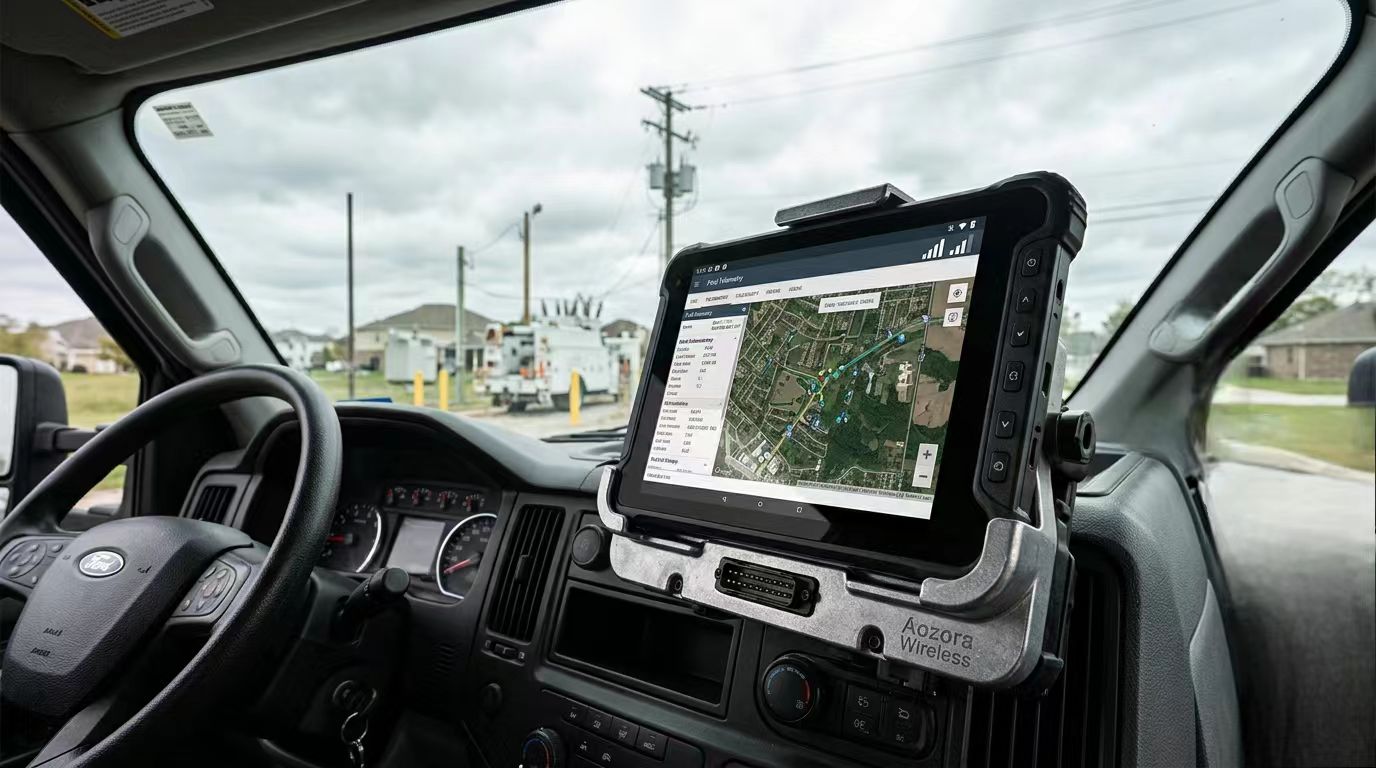
[Vehicle Battery] ──> [14-Pin Pogo Pin Cradle] ──> [Android Rugged Tablet] <──[Wi-Fi 6]──> [Aozora 5G CPE Router]
The crew deploys a service truck equipped with an off-grid industrial wireless gateway connected directly to the vehicle's secondary battery system. The router instantly pulls down a 5G or 4G LTE signal from the nearest surviving carrier tower and broadcasts a local, high-security Wi-Fi 6 field network around the entire workspace.
Technicians step out of the truck carrying an Android rugged tablet or a MIL-STD-810H Android 14 tablet. These field units pull real-time grid data, high-resolution GIS maps, and diagnostic workflows directly through the truck's cellular gateway.
When the tablet needs a charge, the technician drops it into a heavy-duty 14-pin pogo pin vehicle cradle tablet dock mounted to the dashboard. Unlike fragile USB ports that break when shaken on gravel roads, the heavy-duty copper pogo pins handle vibration and high-amperage charging without wearing out.
Feature | Industrial Grade (Aozora) | Consumer Grade |
Cellular Certifications | Verizon Approved, AT&T FirstNet, PTCRB | None (Consumer SIM only) |
Charging Interface | 14-Pin Copper Pogo Pin | Wear-prone USB-C Port |
Ingress Protection | IP69K Waterproof & Dustproof | IP52 or Unrated |
Operating Temp | Industrial Wide-Range (-40°C to 75°C) | Living Room Only (0°C to 35°C) |
Direct Answer: Deploying North American compliant, carrier-certified rugged hardware ensures out-of-the-box readiness and prevents expensive operational downtime during peak energy seasons.
The bottom line is simple: waiting for the summer heatwave to stress-test your communication setup is a costly strategy. When the grid drops, every minute of lost data costs thousands in delayed repairs, safety risks, and compliance penalties.
By deploying an industrial rugged tablet system alongside carrier-certified CPE gateways, you remove wireline infrastructure from your risk equation. You get out-of-the-box readiness across North American networks like T-Mobile, Verizon, and Dish, ensuring your remote field assets remain visible, managed, and secure—even when the local power grid goes offline.


